01
Scale is not leverage
Across the mobilization studies, raw participation is secondary to whether participation converts into lost output, elite withdrawal, administrative degradation, or changed institutional recognition.
Political shock becomes constitutional crisis when institutions stop absorbing it: authority is disputed, administration degrades, payments falter, security chains split, elites defect, or legitimacy no longer compels compliance. This briefing tracks those interactions.
A visual systems map connecting grievances, movements, social actors, state institutions, legitimacy, information, external pressure, and possible outcomes. Use it as an orientation layer for the deeper evidence pages below.
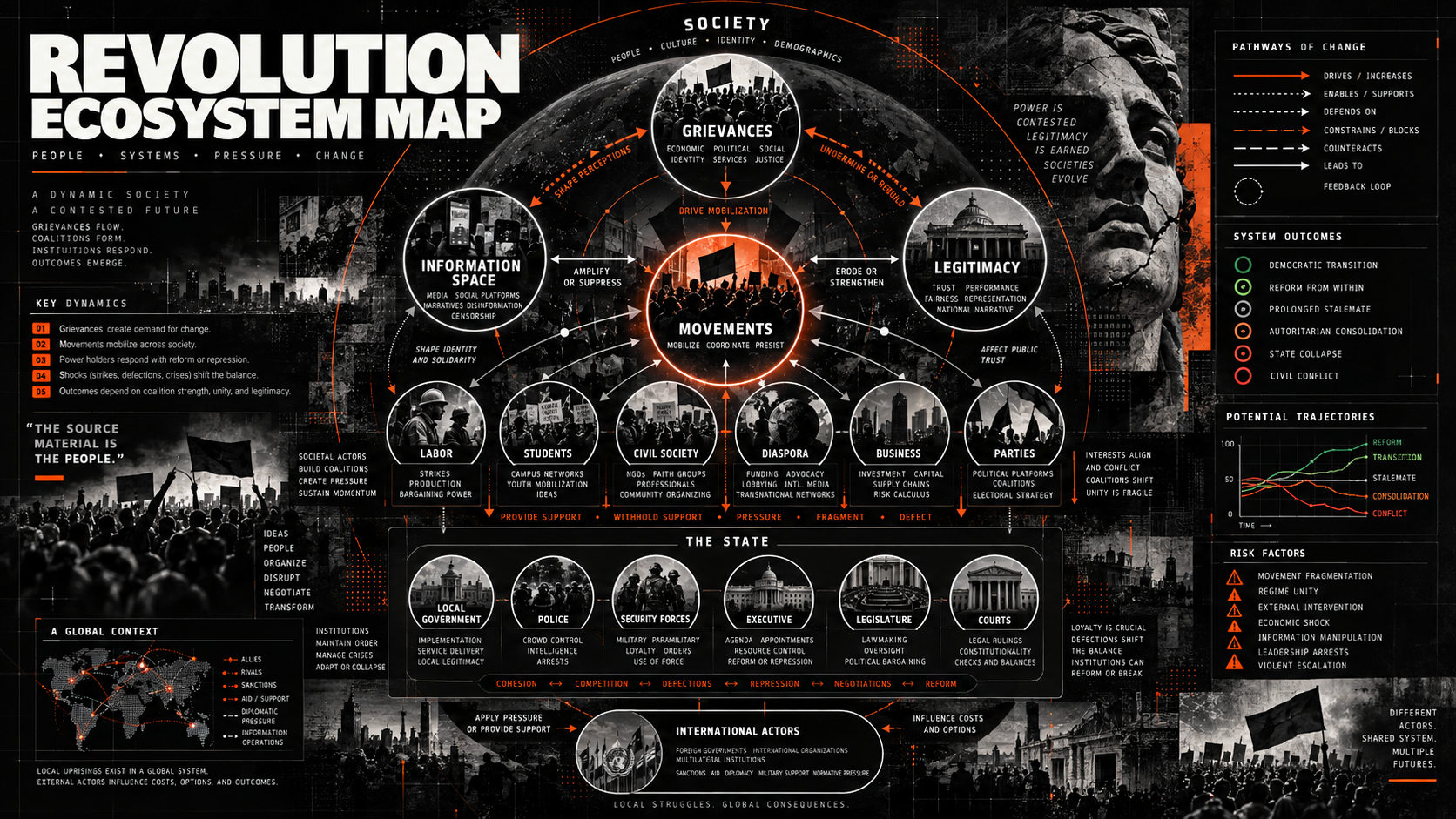
The reports do not promise one path through crisis. They identify recurring mechanisms: legitimacy, enforcement, administration, payments, elite behavior, public pressure, security cohesion, and recovery capacity.
Across the mobilization studies, raw participation is secondary to whether participation converts into lost output, elite withdrawal, administrative degradation, or changed institutional recognition.
Competing claims become a sovereignty problem only when courts, agencies, security organizations, states, payments, contracts, or other durable institutions begin acting under incompatible chains of authority.
Federalism, separate branches, distributed courts, local government, independent election administration, private markets, and multiple security chains make coordination harder—but also make clean capture or clean partition harder.
Individual refusals are noisy. Durable organizational realignment behind incompatible civilian principals is qualitatively different and appears across succession, uprising, federal-state, and executive-capture scenarios.
Litigation itself is normal. The high-signal question is whether consequential actors comply with final judgments and whether judicial decisions still translate into administrative behavior.
A government can remain formally intact while mission output degrades. Conversely, political confrontation can remain bounded while money clears, contracts remain enforceable, benefits are administered, and routine obligations continue.
Foreign amplification and domestic rumor matter most when they disrupt the ability to authenticate authority, orders, records, payments, and official status—not merely when online volume increases.
The supplied armed and youth scenarios consistently treat violent escalation as a driver of casualties, displacement, emergency measures, and coalition fracture—not a mechanical path to political success.
Courts, elections, succession, negotiated concessions, appropriations, service restoration, verified information, and professional command processes reinforce one another when they work.
The severe tail in nearly every report requires multiple rare failures to occur together. Single indicators have high false-positive rates; correlated institutional degradation is the stronger signal.
The revolutionary claim is strongest when a grievance is no longer understood as a bad decision inside a workable order, but as a recurring output of the order itself. The counterclaim is that institutional delay, conflict, and failure can be severe without proving that peaceful correction is exhausted.
When failures recur across administrations and institutions, the relevant diagnosis may shift from personnel and policy toward rules, incentives, ownership, representation, or authority structures that systematically reproduce the same outcomes.
The case for systemic replacement gains analytical weight when voting, courts, oversight, bargaining, transparency, leadership turnover, and prior reform attempts repeatedly fail to alter the underlying grievance—and when that failure is traceable to durable institutional mechanisms rather than a single loss or delay.
Accountability, enforceable judgments, peaceful turnover, meaningful concessions, durable rights expansion, restored public services, institutional redesign, and policy change all cut against the claim that the existing order has no corrective capacity.
Low trust, large demonstrations, radical language, isolated violence, or even support for major constitutional reform do not by themselves establish a preference for regime replacement. The corpus repeatedly separates dissatisfaction, reform, withdrawal, system rejection, and violent action.
The strongest signals are paired measures of political pressure and institutional capacity.
Do institutions still agree on who may exercise lawful authority?
Do consequential actors obey binding judgments after appeals/clarification?
Are disputes order-specific, or are organizations recognizing incompatible principals?
Do lawful obligations, payrolls, contracts, grants, and settlements continue to clear?
Can agencies, states, and local governments still execute standing law and deliver services?
Are statements becoming resignations, voting defections, withdrawal of material cooperation, or durable realignment?
Are conflicts still litigated/bargained inside one legal system, or are common arbiters being rejected?
Can public and institutional actors authenticate orders, status, records, and incident facts?
Read across the rows: what starts the scenario, what actually moves the outcome, what is commonly over-read, what would represent phase change, and what tends to bound the crisis.
| Scenario | Initiating stress | Decisive variables | Not enough by itself | Phase-change threshold | Stabilizers |
|---|---|---|---|---|---|
| Mass nonviolent paralysis | Mobilization / labor disruption | Elite + labor conversion; court/election viability; security cohesion | Huge demonstrations alone | Persistent multi-system withdrawal of cooperation | Courts, elections, concessions, service recovery |
| Armed escalation | Violent tail inside broader movement | Security cohesion; weaponization; lifeline continuity | Weapons or turnout alone | Persistent organized violence + institutional fracture | Political channels, unified lawful command, lifeline restoration |
| Youth contagion | Transnational social learning + domestic grievance | Persistence; state response; coalition breadth; violent fringe | Youth anger or online volume alone | Violent tail normalizes while off-ramps fail | Transparent information, proportionate response, negotiation/elections |
| Executive capture | Incremental or abrupt concentration of executive power | Cross-institutional loss of corrective capacity | Rhetoric or hardball governance alone | Final judgments/appropriations/elections no longer constrain power | Courts, Congress, states, elections, professional process |
| Contested succession | Competing claims to executive authority | Operational recognition across agencies/security/payments/courts | Competing press claims | Durable government functions split across incompatible chains | Authentication, succession law, courts, Congress, records |
| Security fracture | Order-lawfulness and command disputes | Organizational recognition + sustainment | One refusal or resignation | Durable rival command chains with resources and civilian principals | Legal review, replacement, courts, common civilian authority |
| Federal–state fracture | Constitutional/federalism confrontation | Judicial compliance; payment finality; Guard status; private-sector recognition | Lawsuits, coalitions, declarations | Independent systems reject common arbiter and align into rival orders | Courts, markets/payments, bargaining, local heterogeneity |
| Leadership loss | Loss/isolation of senior leaders | Status determination; Congress; acting authority; court capacity | Communications loss alone | Authority ambiguity persists across branches and agencies | Succession/delegation, Congress, reconstitution |
| Fiscal breakdown | Funding/admin degradation | Duration; staffing; payment/procurement throughput; state substitution | Shutdown headline alone | Multiple functions fail faster than redundancy can absorb | Standing authority, payments, states, mutual aid, backlog recovery |
| Foreign amplification | External exploitation of genuine domestic ambiguity | Authentication; attribution discipline; behavioral conversion | Virality or ideological similarity | Institutions act on unverified/fabricated authority narratives | Redundant authenticated channels, records, independent confirmation |
| Resistance law | Conflict between political philosophy and positive law | Correct legal category; current doctrine; historical transferability | Historical rhetoric alone | Historical/normative claims misrepresented as current legal immunity | Separate philosophy/history/doctrine/statute; current legal review |
Pair mobilization, legitimacy, security, fiscal, administrative, and information signals instead of collapsing them into a single instability score.
Open indicators →Continuity + off-rampsCourts, elections, succession, bargaining, payments, services, authenticated information, and reconstitution are the system’s main absorption mechanisms.
Open continuity →The 21 original scenario/source reports remain the controlling authority layer for the original scenario syntheses. The wider library now contains 82 public report readers, with later analytical and knowledge-architecture work labeled separately. Current-sensitive material should still be re-verified before present-tense reuse.
Continue through linked mechanisms, institutions, outcomes, cases, law, and glossary entries built from the same report corpus.
Twelve case dossiers separate chronology from mechanism and explicitly state what transfers—and what does not—before any U.S. analogy is drawn.
Sixteen institution profiles separate normal governance, stress behavior, phase-change indicators, common false positives, dependencies, and restoration requirements.
Twelve consultant briefs connect the strongest recurring findings across the research library.