- Can the institution still execute its lawful function?
- Does it recognize the same controlling authority as peer institutions?
- Can ordinary review, appeal, elections, appropriations, bargaining, or succession still correct conflict?
- Is stress isolated or correlated across independent systems?
Institutions carry power.
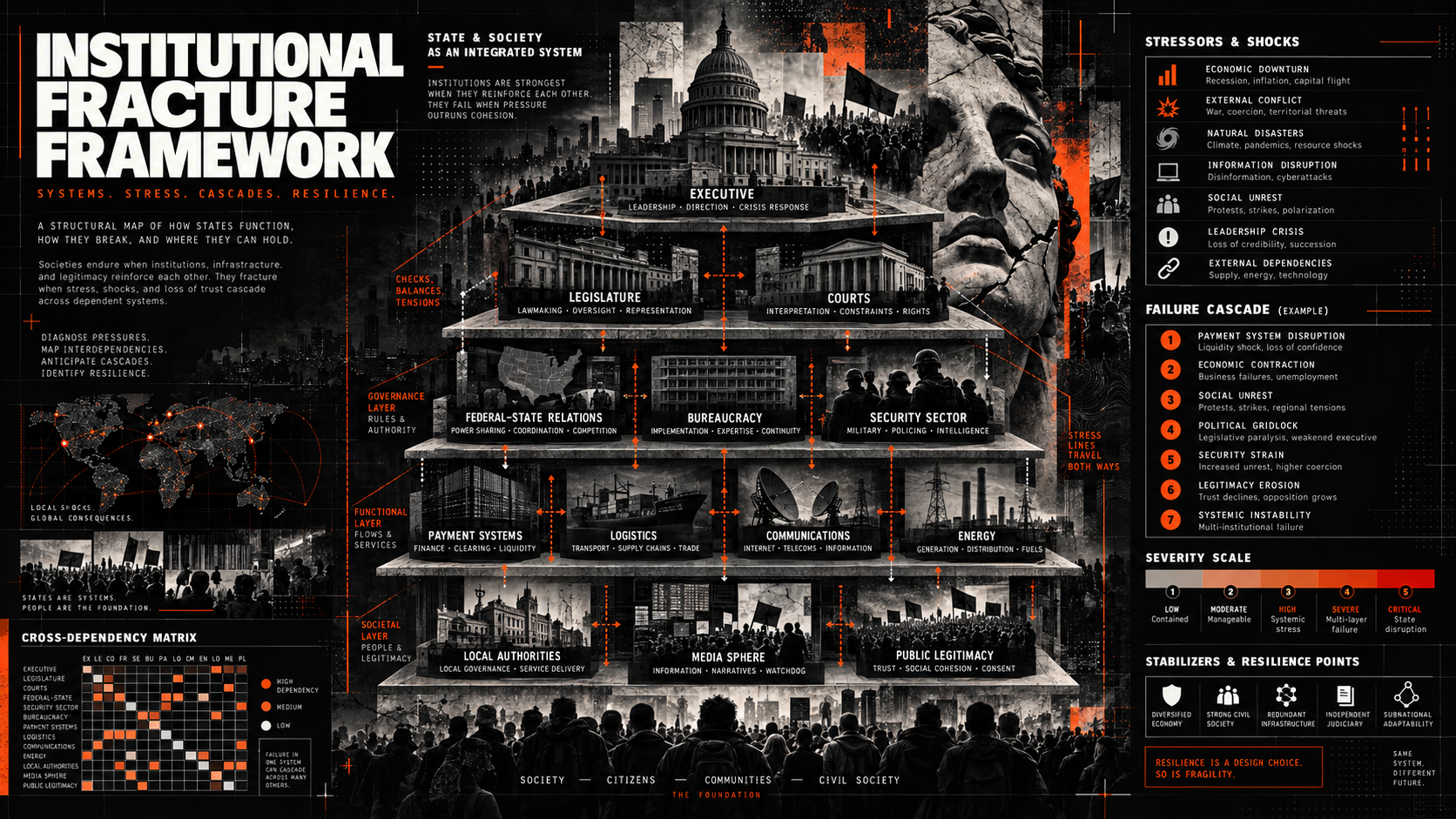
Sixteen dossiers examine the structures that make authority real: executive command, legislatures, courts, security institutions, payments, administration, labor, business, media, and civil society. Crisis becomes consequential when these systems stop moving in the same direction.
Institutional fracture framework
A layered view of governance, essential systems, legitimacy, and cross-system dependencies. It is designed to make cascading institutional stress easier to reason about without reducing the system to a single failure point.

Read institutions as power systems.
Each dossier separates formal authority from actual capacity, then tracks command, compliance, dependence, fracture, correction, and recovery. The question is not whether an institution exists on paper, but what it can still make happen.
- Equating criticism with institutional defection.
- Equating deployment or continuity activation with political alignment.
- Converting market moves or protest size into constitutional conclusions.
- Using institutional mapping for targeting, disruption, coercion, evasion, or sabotage.
Open a dossier.
The institutions overlap. Follow their dependencies and related mechanisms rather than reading any one page as a standalone prediction.
Presidency
The presidency is central to executive direction but not a single point from which all legal authority originates. The corpus emphasizes succession, incapacity, delegation, appropriations, judicial review, and office-specific authority.
Open dossier →institution dossierCongress
Congress is both a political institution and a continuity mechanism: appropriations, confirmations, oversight, succession-related functions, chamber leadership, and legislation can become decisive during crises.
Open dossier →institution dossierFederal Courts
Courts matter because they can convert political conflict back into a common legal process—if consequential actors comply. Their role is strongest when they retain jurisdiction, remedies, quorum, and practical enforcement.
Open dossier →institution dossierState Governments
States are independent governing institutions inside the federal constitutional system. Their ability to refuse some forms of federal implementation creates resilience and conflict, but state authority is not a general veto over valid federal law.
Open dossier →institution dossierLocal Government
Cities, counties, emergency services, local courts, transit, utilities, and police create intrastate heterogeneity. This makes clean state blocs harder to sustain and creates important redundancy during federal or state dysfunction.
Open dossier →institution dossierElections
Elections function as both a legitimacy source and an off-ramp when they remain administratively viable and broadly accepted as a mechanism for leadership change. The reports distinguish official processes from media calls or foreign recognition.
Open dossier →institution dossierMilitary
The military matters most at the point where civilian legitimacy disputes threaten a commonly recognized legal chain. The corpus emphasizes organizational cohesion, lawful civilian authority, legal review, and the difference between order-specific disputes and sovereign realignment.
Open dossier →institution dossierNational Guard
The Guard’s dual federal-state legal architecture makes status, mission, funding, and command central to federal-state crisis analysis. State Active Duty, Title 32, and Title 10 are not interchangeable.
Open dossier →institution dossierLaw Enforcement
Law-enforcement institutions sit at the boundary between ordinary public-order response and deeper constitutional stress. Their analytical significance comes from lawful mission performance, cross-agency cohesion, and whether enforcement becomes tied to incompatible claims of authority.
Open dossier →institution dossierCivil Service & Administration
Career officials, acting officers, delegated authority, inspectors, acquisition staff, benefits administrators, and regulators keep routine government functioning below the level of political leadership.
Open dossier →institution dossierLabor
Labor can translate political mobilization into economic and service effects, but the analytical variable is sustained participation plus measurable output loss—not symbolic solidarity.
Open dossier →institution dossierBusiness & Private Firms
Private firms shape logistics, investment, employment, contracting, insurance, communications, and market confidence. The reports caution against treating statements as equivalent to costly material behavior.
Open dossier →institution dossierBanking & Payments
Banking and payment systems are practical continuity infrastructure. They expose whether obligations remain payable, settlement remains final, contracts remain enforceable, and firms still operate inside one legal framework.
Open dossier →institution dossierMedia & Information Systems
Information systems become critical when institutions and the public must establish what happened, who holds office, whether orders are authentic, and what legal process controls. The reports emphasize authentication over volume.
Open dossier →institution dossierUniversities & Civil Society
Universities and civil-society organizations can provide dense social networks, expertise, advocacy, legal support, public meetings, and mediation. They are coordination environments, not automatic sources of revolutionary alignment.
Open dossier →institution dossierDefense Industrial Base
The defense-industrial material treats contractors as continuity-dependent regulated actors, not alternative sovereigns. Authority verification, contracting authority, payments, supply chains, access control, and records are the key concerns.
Open dossier →