01
Authority validation
Resolve who lawfully holds an office, what delegation exists, and whether the office has authority over the specific action. Authentication and legal authority are separate tests.
Political orders survive stress when authority remains recognizable: courts are obeyed, elections remain usable, payments clear, services function, succession is understood, information can be authenticated, and administration can still act. Recovery is not background. It is part of the contest over whether one political order remains coherent.
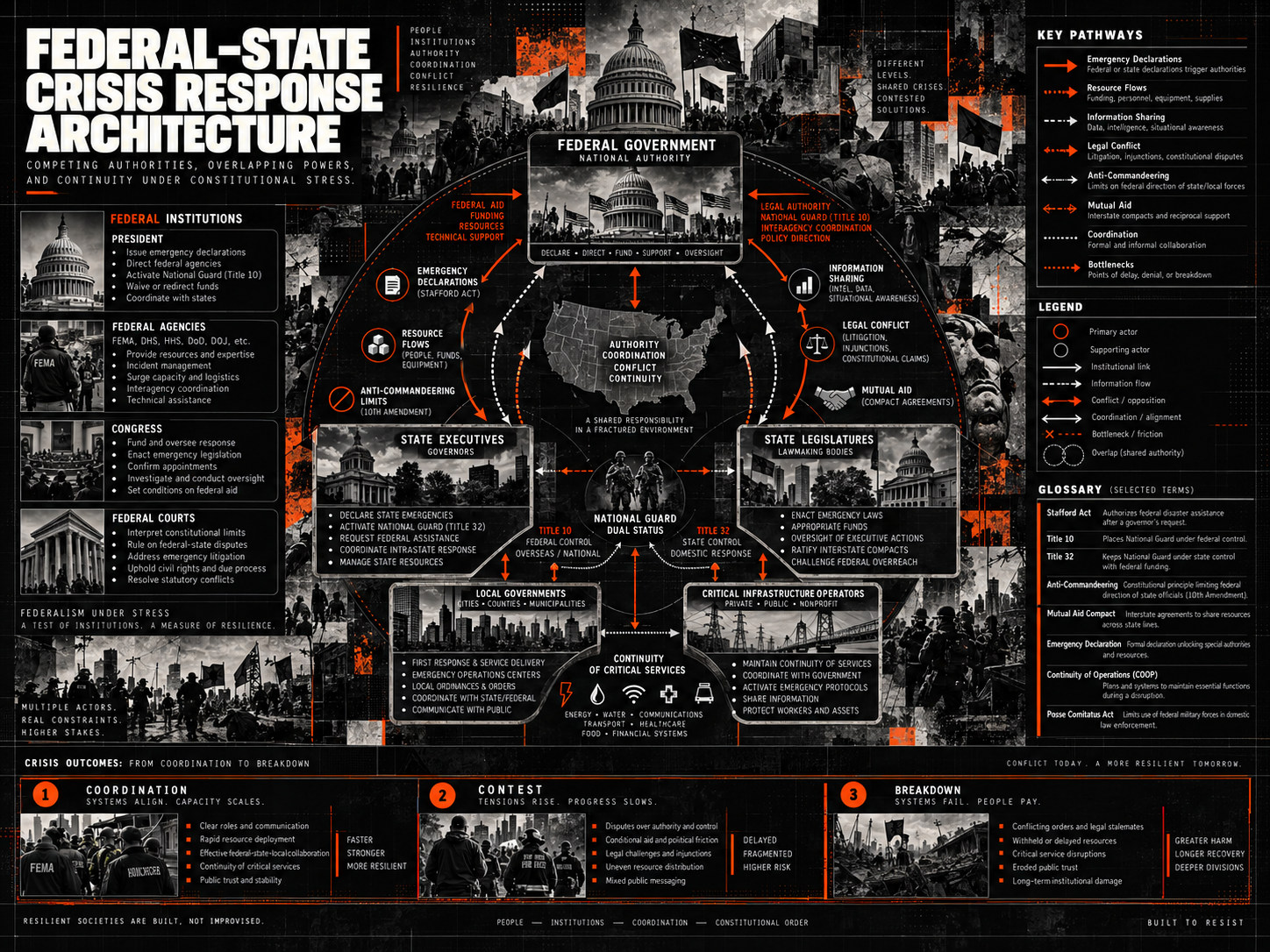
A high-detail architecture of federal, state, local, Guard, court, and continuity relationships under severe stress.
None is sufficient alone. They reinforce one another.
Resolve who lawfully holds an office, what delegation exists, and whether the office has authority over the specific action. Authentication and legal authority are separate tests.
Courts are stabilizers only when consequential actors can obtain rulings and those rulings translate into compliance.
Credible elections and lawful succession give political conflict a recognized path to change leadership without creating rival sovereignty.
Payroll, benefits, contracts, grants, and final settlement keep ordinary life and institutional obligations attached to one legal order.
Healthcare, transport, communications, utilities, emergency response, and local administration buy time for political resolution when they remain available.
States, local governments, courts, agencies, and mutual-aid systems can substitute for impaired functions without becoming a rival government.
Established channels, independent confirmation, logs, and records reduce the chance that political ambiguity becomes an authority-impersonation problem.
Continuity is incomplete until temporary arrangements return to ordinary governance, successor lists and delegations are repaired, and backlogs are processed.
These are review windows, not forecasts.
Authentication, status, continuity activation, public-information integrity, and preservation of ordinary safety/legal duties. Information risk can peak before institutions have sorted the underlying event.
Institutional sorting: courts, legislatures, elite behavior, labor, security cohesion, state-federal relations, bargaining, and whether incompatible authority claims gain practical recognition.
Persistence after costs become visible: service restoration, payments, business behavior, administrative divergence, narrative hardening, and whether emergency arrangements remain bounded.
Reconstitution versus institutional hardening. Elections, permanent appointments, legal settlement, administrative repair, or—only in extreme compounded cases—durable fragmentation and prolonged internal-security conflict.
Continue through linked mechanisms, institutions, outcomes, cases, law, and glossary entries built from the same report corpus.