Mechanisms Library · Reference Desk

Mobilization vs. Capacity

The corpus separates public pressure from the state’s ability to keep governing. Participation becomes systemically consequential when it converts into lost output, administrative degradation, institutional withdrawal, or altered recognition of lawful authority.

Movement schematic · visual reference

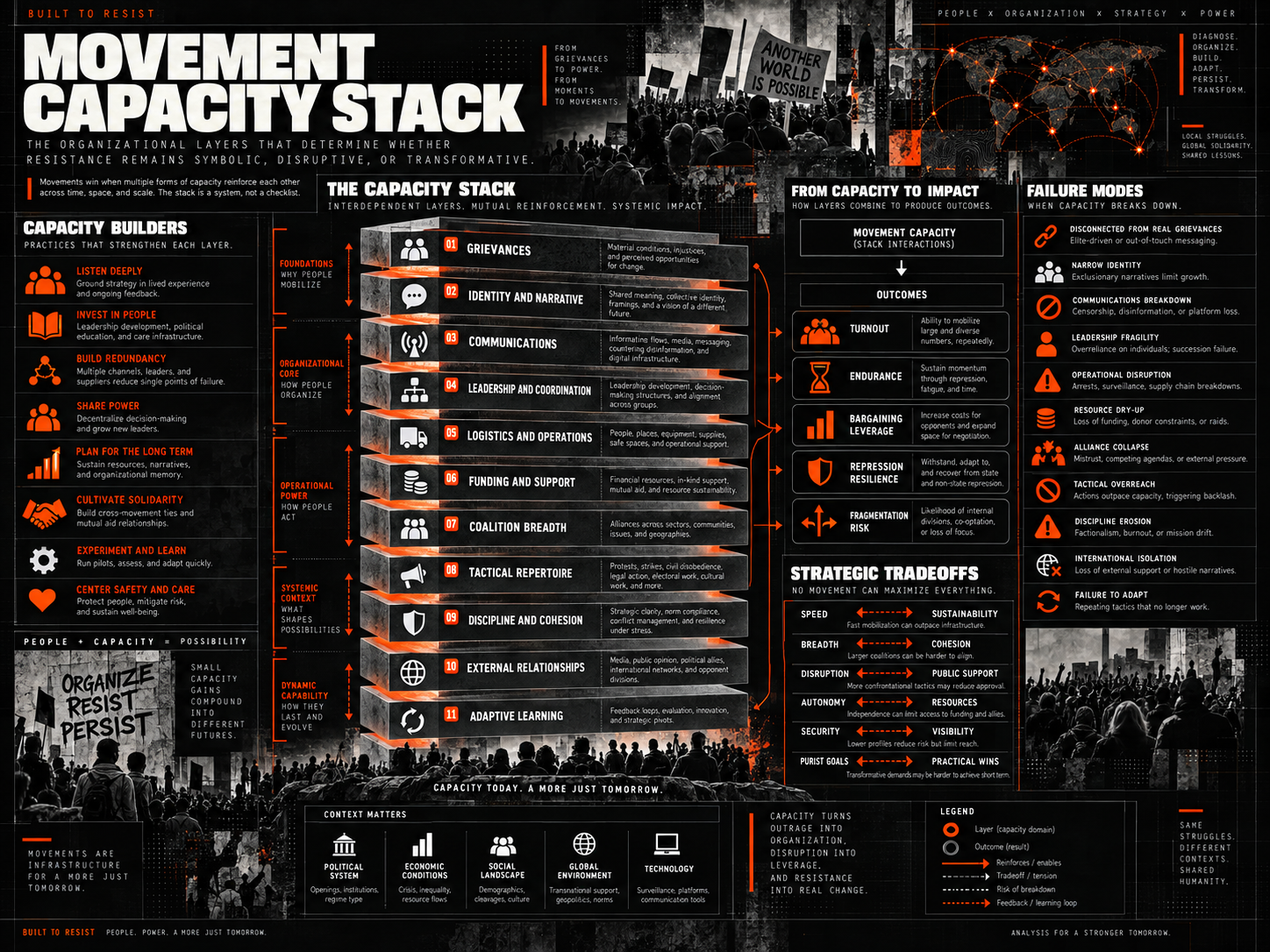
Movement capacity stack

A layered infographic separating turnout from organization, logistics, communications, discipline, resources, and institutional conversion.

Detailed movement capacity stack infographic showing layers of mobilization, organization, logistics, narrative, discipline, resources, and institutional conversion.
A layered model showing why visible mobilization is only one layer of movement capacity. Open the image for the full-resolution schematic.Source text and cited research control where a visual label is simplified.
What the corpus supports
  • Pair turnout with actual service output, staffing, backlogs, payment continuity, and restoration time.
  • Track persistence and cross-sector spread rather than one-day peaks.
  • Treat elite, labor, business, and security behavior as conversion mechanisms between public pressure and governing capacity.
Do not over-read
  • A record crowd is not the same thing as state paralysis.
  • A formal continuity activation is not evidence that government has ceased functioning.
Deep Dossier 01Research DossierAll deep dossiers →
Executive synthesis

What changes the diagnosis.

The supplied research treats mobilization and governing capacity as separate analytical systems. Large demonstrations, strikes, occupations, boycotts, or online attention can create intense political pressure while courts, payments, elections, public administration, security command, and essential services continue to function.

The phase change occurs when visible pressure is converted into institutional behavior: sustained output loss, widening administrative failure, consequential elite withdrawal, declining acceptance of courts or elections, or uncertainty inside lawful security chains. The mass-mobilization report expresses this as a conceptual interaction between durable mobilization and institutional absorption capacity, not as a calibrated prediction formula.

For analysis, the most important discipline is therefore pairing every mobilization measure with a capacity measure. Attendance should be read alongside service availability; labor participation alongside output loss; elite criticism alongside resignations or voting behavior; and security rhetoric alongside actual lawful mission performance.
Threshold model

Separate signal from spectacle.

The threshold table describes analytical categories, not a forecast, score, or instruction for producing political outcomes.

LayerWhat to observeInterpretation
Public pressureParticipation, geographic spread, coalition breadth, labor activity, public supportHigh visibility without institutional conversion can remain politically consequential but systemically containable.
Capacity degradationStaffing loss, service delays, payment friction, logistics disruption, court backlogSeverity depends on persistence, cross-sector correlation, and restoration time—not the existence of disruption alone.
Institutional conversionResignations, legislative defections, material business withdrawal, rejected judgments, command uncertaintyThis is the bridge from political pressure toward a governing-capacity or legitimacy crisis.
Compound phase changeSeveral independent systems degrade together while off-ramps failCo-occurrence matters more than any single dramatic indicator.
Cross-scenario evidence

One mechanism. Different contexts.

Each scenario contributes a different part of the evidence. Transferability limits stay visible rather than being averaged away.

Scenario / corpusWhat it contributesLimit / caution
Mass Nonviolent ParalysisPaired mobilization/capacity metrics; raw turnout is secondary to institutional conversion.No empirically calibrated threshold converts protest size into political transition.
Fiscal-Administrative BreakdownGovernment failure is a degradation spectrum across staffing, payments, procurement, courts, services, and states.Fiscal disruption can be severe without transferring constitutional authority.
Youth Uprising ContagionScale interacts with persistence, state response, and violence; crowd size alone is insufficient.Scenario ranges are planning envelopes, not forecasts.
Security-Sector FractureCohesion and common lawful authority matter more than isolated refusals.Comparative authoritarian cases transfer only partially to U.S. institutions.
Alternative explanations

What else could produce the same signal?

  • Natural disaster, cyber outage, pandemic, infrastructure accident, or labor shortage can produce service degradation without revolutionary politics.
  • Large but routine demonstrations can coincide with intact courts, elections, payments, administration, and security chains.
  • Continuity activation may indicate resilience rather than collapse; the relevant question is whether mission output is preserved.
Confidence & transferability

Where the evidence stops.

  • High confidence in the conceptual separation between mobilization and state capacity.
  • Medium confidence in the ordering and interaction of institutional conversion mechanisms.
  • Low confidence in any universal numerical threshold for turnout, duration, or disruption.

Currentness gate. Structural mechanism is durable. Present-tense claims about agency capacity, legal authorities, fiscal conditions, or security posture require current verification.

Source-section anchors

Go directly to the controlling analysis.

These links identify the report sections used to structure this dossier. Report bodies are preserved unchanged.

Connections

Follow the mechanism.

BuiltToResist is designed as a linked research system: concepts should lead into the institutions, outcomes, cases, and legal categories they affect.

Source base

Read the underlying reports.

This page synthesizes the supplied research. Current-sensitive legal, institutional, fiscal, and threat claims should be rechecked before present-tense reliance.