
The research disaggregates refusal, shirking, neutrality, resignation, desertion, withdrawal of support, organizational side-switching, and coups. The decisive transition is not a headline-making refusal; it is durable organizational recognition of incompatible civilian principals, backed by administration, resources, and continuing mission execution.
Study 06 · From refusal to organizational realignment
Security-Sector Command Fracture
Security-sector fragmentation is a more serious indicator of constitutional stress than another increment of protest participation, but isolated refusals do not create a new government. The critical question is whether durable organizations accept incompatible civilian authorities.
← All studiesSecurity schematic · visual reference
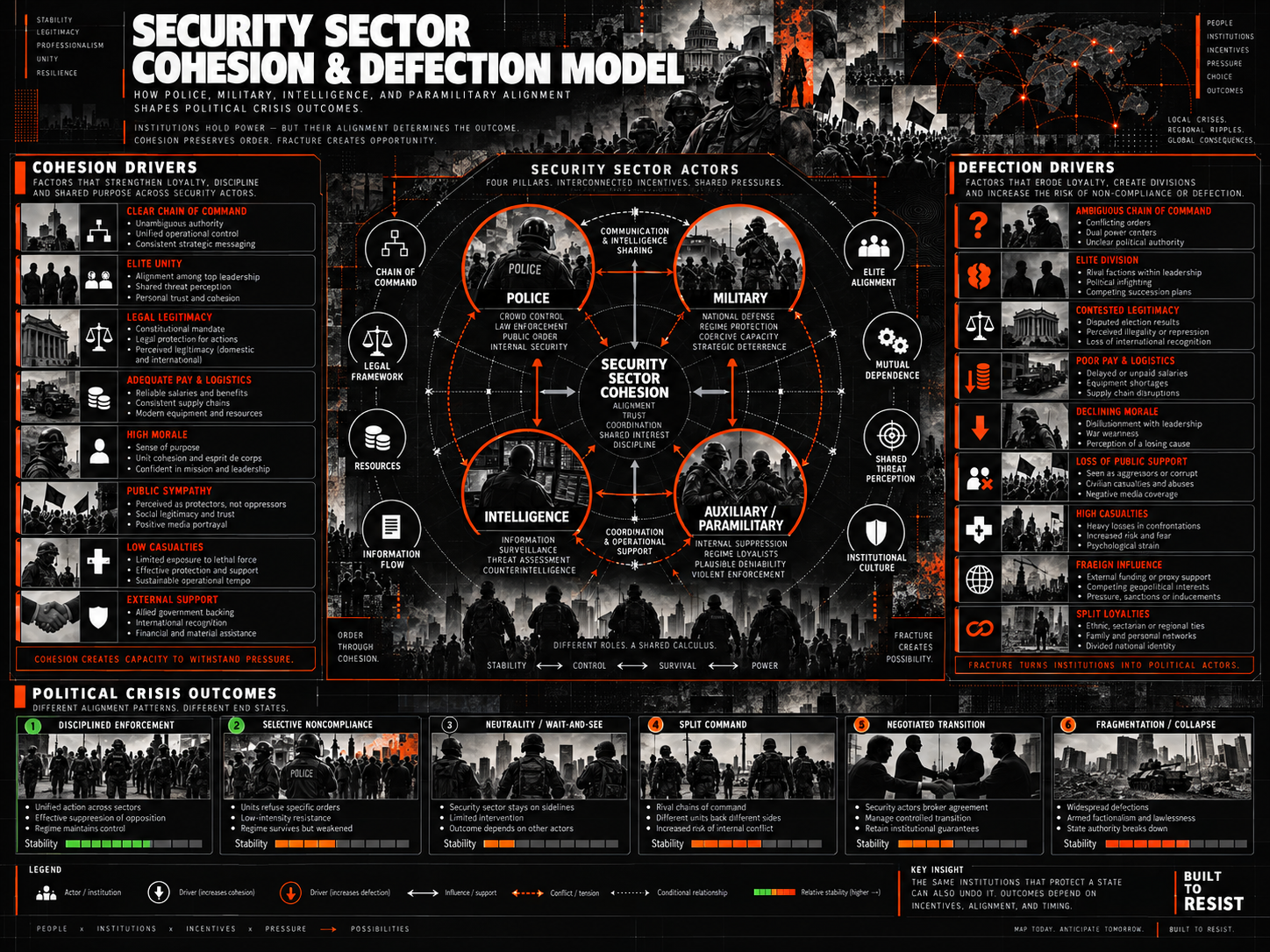
Security-sector cohesion and defection model
A high-detail model of command cohesion, hesitation, defections, fragmentation, and security-sector alignment under constitutional stress.
Baseline judgment
The papers distinguish individual refusal, shirking, neutrality, desertion, organizational side-switching, and coups rather than treating them as one automatic escalation ladder. U.S. forces also operate through multiple distinct federal, state, and local command systems.
Turning points
01
Disputes stay order-specific—or entire organizations change recognition.
02
Command disagreement resolves through law, replacement, or courts—or persists after those interventions.
03
Rival chains acquire durable funding, administration, logistics, and legal recognition.
04
State and federal security systems coordinate despite friction—or begin executing incompatible sovereign commands.
05
Security institutions remain instruments of civilian government—or become independent political claimants.
Outcome ladder
What the scenario can become
These are analytical states, not probability scores or prescriptions.
Outcome 1
Command-and-law crisis
Refusals, removals, litigation, and clarification degrade execution but leave one governmental order.
Outcome 2
Organizational fragmentation
Distinct institutions align differently, producing severe federal-state and continuity risk.
Outcome 3
Sovereignty crisis
The highest-risk case requires durable rival chains with civilian claimants, resources, logistics, and practical control over people, facilities, or territory.
Consultant brief
Decision-grade synthesis
Condensed from the supplied report set for this scenario. Evidence controls the claim; this section is not a forecast or operational playbook.
- Order-lawfulness disputes recurring across independent chains after clarification.
- Spread across multiple systems: active military, Guard organizations, federal law enforcement, state police, local law enforcement, or Coast Guard.
- Disagreement penetrating institutional leadership rather than remaining individual.
- Rival chains acquiring durable fiscal, logistical, personnel, and administrative support.
- Security institutions continuing to act after courts, Congress, succession rules, or replacement processes have attempted resolution.
- One refusal is normally a personnel-and-lawfulness event, not sovereignty transfer.
- State/federal Guard friction can occur inside functioning constitutional processes.
- Authoritarian coup cases have limited transferability to a decentralized U.S. security architecture.
- Written orders, legal review, judge advocates/counsel, replacement processes, and judicial clarification.
- Common recognition of lawful civilian authority even when policy disputes are severe.
- Clear status, funding, and mission definitions for Guard and other mixed federal-state structures.
- Organizational professionalism and continuity of ordinary mission performance.
- There is no validated quantitative tipping point from scattered dissent to durable competing chains.
- Unclassified evidence about unit-level behavior under unprecedented constitutional ambiguity is necessarily limited.
- Specific predictions should remain lower-confidence than the legal and organizational framework.
Research basis
This page is a condensed synthesis of the supplied project research. It preserves the source framing at a non-operational level and deliberately excludes tactical instructions for violence, sabotage, evasion, infiltration, or coercion.
Security-Sector Command Fracture in a U.S. Constitutional Crisis Cohesion, Lawful Authority, and Sovereignty Risk.mdsha256 73a2c71ec071…Security-Sector Command Fracture U.S. Civil–Military Framework.mdsha256 ebb4c4235415…Security Sector Fracture Analysis.mdsha256 3ee0ba3757da…
Study ID
security-sector-fracture · machine-readable provenanceReference connections
Follow the system.
Continue into the mechanisms, institutions, outcomes, cases, and law that shape this scenario.