Mechanisms Library · Reference Desk

Information Authentication

In severe legitimacy crises, the ability to authenticate orders, officeholder status, records, court decisions, alerts, and financial instructions becomes infrastructure. The foreign-amplification reports emphasize that epistemic breakdown can be damaging even without persuading a majority.

Information schematic · visual reference

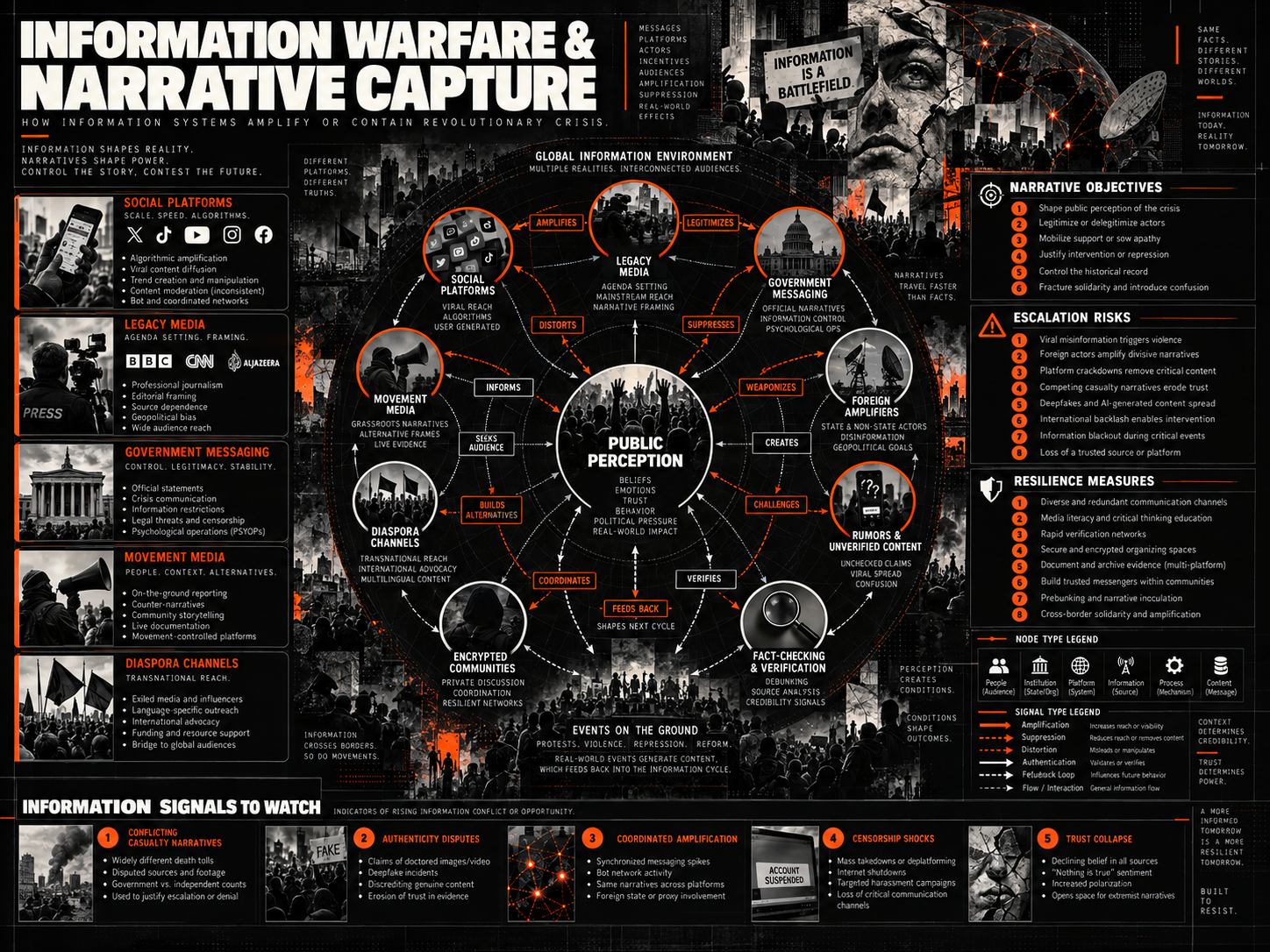
Information warfare and narrative capture

A high-detail visual of narrative competition, authentication failure, rumor cascades, platform amplification, and trust erosion.

Detailed information warfare and narrative capture schematic showing rumor, propaganda, platform amplification, authentication, disinformation, and trust breakdown.
A systems visual showing how narrative capture and authentication failure can intensify crisis conditions. Open the image for the full-resolution schematic.Source text and cited research control where a visual label is simplified.
What the corpus supports
  • Separate content authenticity, coordination, foreign nexus, state direction, and real-world effect.
  • Use preexisting channels and independent confirmation for consequential instructions.
  • Preserve logs and conflicting messages so later reconciliation is possible.
Do not over-read
  • Virality is not authenticity.
  • A real sender may lack authority for a specific action, and a lawful order may arrive amid false narratives about the sender.
Deep Dossier 07Research DossierAll deep dossiers →
Executive synthesis

What changes the diagnosis.

The foreign-amplification reports frame the central information risk as epistemic uncertainty rather than simple persuasion. In a severe legitimacy crisis, the destabilizing effect can come from uncertainty about which orders, rulings, alerts, casualty reports, financial notices, or official communications are authentic—even when no foreign actor can determine the political outcome.

The analytical model separates five propositions that should never be collapsed: whether underlying content is authentic, whether amplification is coordinated, whether a foreign nexus exists, whether a state directs the activity, and whether the activity materially changes domestic behavior. Confidence can differ at every layer.

This distinction prevents two common errors: treating repeated or ideologically convenient content as proof of foreign direction, and treating exposure or reach as proof of political effect. Authentication, provenance, authority, and effect must be evaluated separately.
Threshold model

Separate signal from spectacle.

The threshold table describes analytical categories, not a forecast, score, or instruction for producing political outcomes.

LayerWhat to observeInterpretation
Content uncertaintyUnverified video, document, casualty report, alert, or orderRequires authentication; falsity of provenance and falsity of substance are separate questions.
Coordination evidenceNetwork behavior suggests organized amplificationDoes not by itself establish foreign sponsorship or state direction.
AttributionTechnical, financial, administrative, legal, intelligence, or partner evidence convergesConfidence should distinguish foreign involvement from state direction.
Behavioral conversionDecision-makers, firms, agencies, markets, or security institutions change action because of the informationThis is the relevant transition from information turbulence to institutional effect.
Cross-scenario evidence

One mechanism. Different contexts.

Each scenario contributes a different part of the evidence. Transferability limits stay visible rather than being averaged away.

Scenario / corpusWhat it contributesLimit / caution
Foreign-Amplified Legitimacy FractureSeparates authenticity, coordination, foreign nexus, state direction, and effect.Attribution confidence and effect confidence can diverge sharply.
Foreign-Amplified Domestic Legitimacy FractureProcedural legitimacy and authority verification are stronger continuity defenses than political persuasion.Foreign exploitation usually depends on genuine domestic ambiguity and validators.
Contested SuccessionAuthority recognition depends on institutional/legal verification, not media popularity or foreign recognition.Authentic communications can still come from an office lacking transaction-specific authority.
Leadership LossAuthority can exist legally while becoming ineffective if identity and communication cannot be authenticated.Common-mode communications failure is an extreme contingency, not a default assumption.
Alternative explanations

What else could produce the same signal?

  • Organic domestic rumor, partisan reinterpretation, ordinary journalism error, or independent repetition can resemble coordinated amplification.
  • Service outages may be technical, accidental, or criminal without political causation.
  • A genuine leaked document can be mixed with fabricated material; authenticity must be item-specific.
Confidence & transferability

Where the evidence stops.

  • High confidence in separating provenance, sponsorship, state direction, and effect as distinct analytical questions.
  • Medium confidence in attributing political impact even when sponsorship is well established.
  • Low confidence in inferring coordination or foreign direction from content similarity alone.

Currentness gate. Very high currentness sensitivity for named foreign actors, capabilities, attribution cases, and threat assessments. Reverify before present-tense use.

Source-section anchors

Go directly to the controlling analysis.

These links identify the report sections used to structure this dossier. Report bodies are preserved unchanged.

Connections

Follow the mechanism.

BuiltToResist is designed as a linked research system: concepts should lead into the institutions, outcomes, cases, and legal categories they affect.

Source base

Read the underlying reports.

This page synthesizes the supplied research. Current-sensitive legal, institutional, fiscal, and threat claims should be rechecked before present-tense reliance.