Comparative method · Turning points
Track the moment power changes behavior.
Turning points are not dramatic moments by definition. They are events that alter what institutions, elites, security forces, movements, or publics are willing or able to do next.
Event schematic · visual reference
Turning-point atlas
A visual reference for recurring event classes—triggers, mobilization surges, strikes, crackdowns, defections, elite splits, judicial decisions, parallel institutions, leadership exits, restoration, and transition—without implying a universal sequence.
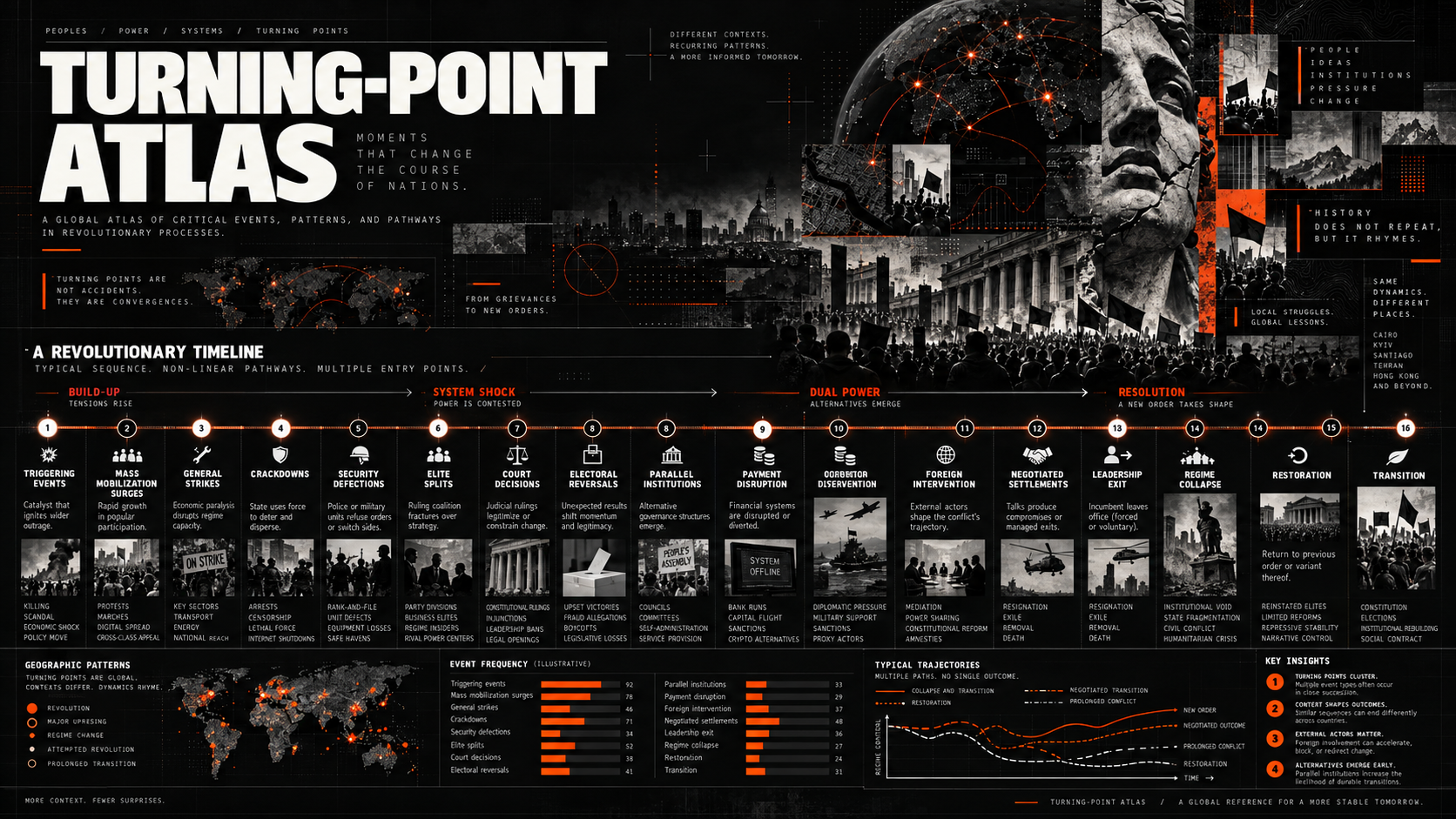
| Event class | Why it matters |
|---|---|
| Mass mobilization | Participation changes the political agenda but does not by itself show loss of state capacity. |
| General strike / sustained labor withdrawal | Economic leverage rises when absenteeism or strike participation produces measurable output loss. |
| Elite resignation or legislative defection | Speech becomes institutional withdrawal. |
| Security-sector neutrality shift | A high-signal change only when organizational behavior, not isolated statements, changes. |
| Security-force defection | Can become a phase-change variable when durable organizational loyalty changes. |
| Court ruling and compliance | Legal finality matters when judgments alter behavior. |
| Court ruling ignored | A dispute can move from policy conflict toward rule-of-law conflict. |
| Election / plebiscite off-ramp | A recognized electoral channel can convert street conflict back into institutional competition. |
| Negotiated settlement | Coalitions and incumbents accept a bargained termination mechanism. |
| Leadership resignation | Can end one crisis while opening succession and reconstruction problems. |
| Emergency declaration | Low diagnostic value by itself; significance depends on legal constraint and institutional response. |
| Failed crackdown / repression backfire | Coercion expands coalition breadth or elite defections instead of restoring compliance. |
| Successful repression | Mobilization contracts while coercive and administrative systems remain cohesive. |
| Parallel institution formation | Movement legitimacy becomes more consequential when alternative administration gains durable recognition. |
| Competing authority claim | A claim becomes a sovereignty problem only when institutions act on incompatible authority chains. |
| Payment / administrative interruption | Practical sovereignty is tested through payroll, benefits, contracting, grants, and settlement. |
| Foreign amplification episode | Information effects must be separated into authenticity, coordination, foreign nexus, state direction, and behavioral effect. |
| Constitutional restoration | Recovery requires more than leadership change: courts, administration, elections, payments, and records must normalize. |
Use rule
This is a comparative coding framework, not a recipe for producing the event. The analytical unit is observable institutional change and its consequence.