The armed-conflict stress test does not treat weaponization as a shortcut to political success. Its baseline assumption—continued cohesion of the armed forces, courts, most governments, and core administration—is the single strongest reason mass opposition does not automatically become successful revolution. Armed minorities can impose disproportionate human and economic costs while remaining far smaller than the political movement around them.
Study 02 · Stress test of the violent tail
Mass Uprising → Armed Escalation
The armed-uprising paper finds that scale alone is not the key determinant of revolutionary success. State cohesion, elite fracture, administrative control, and security-force alignment dominate the political outcome while violence sharply increases human and economic costs.
← All studiesPathway schematic · visual reference
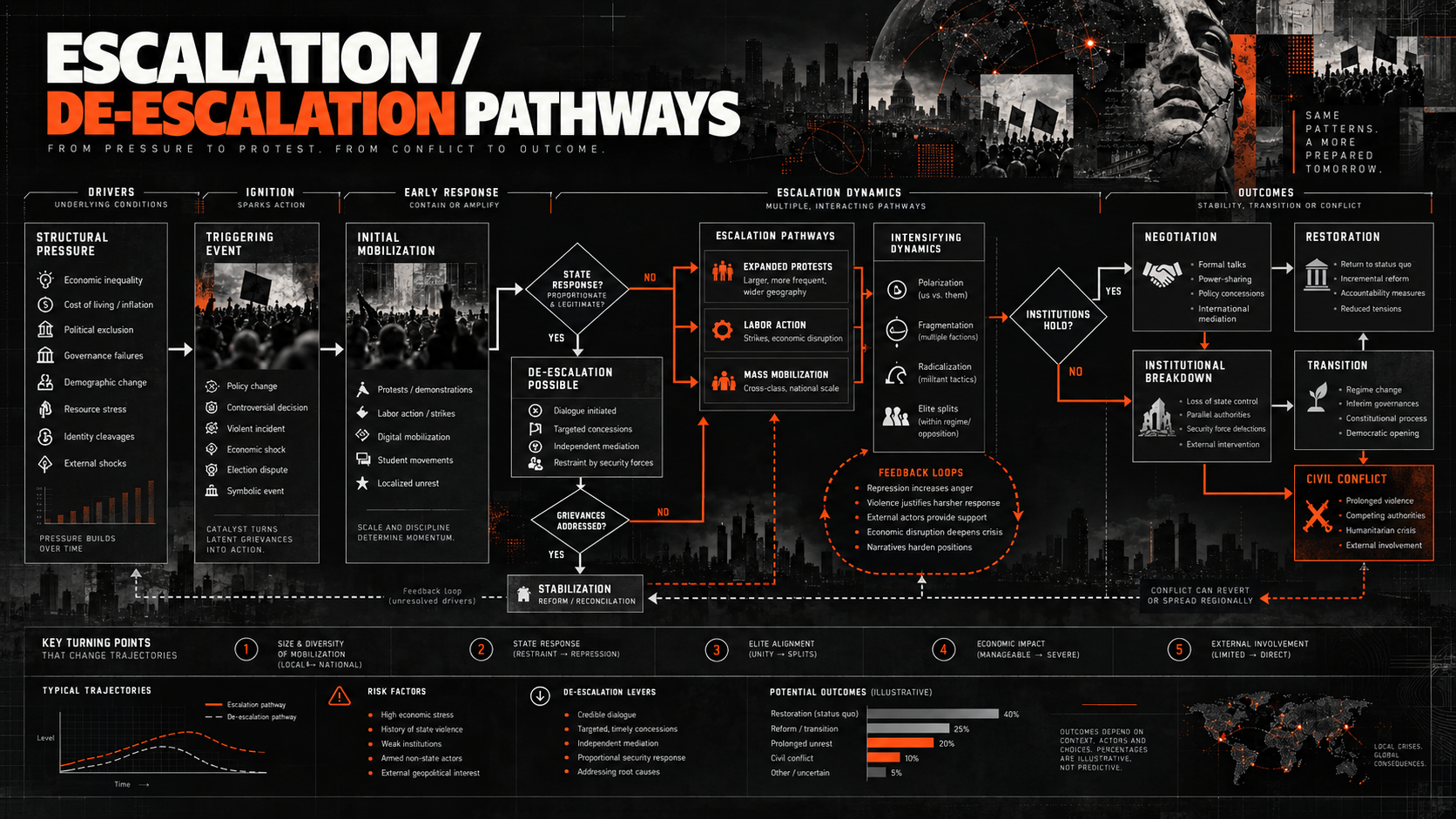
Escalation and de-escalation pathways
An illustrative branch map for reading how structural pressure, trigger events, mobilization, state response, negotiation, institutional stress, restoration, transition, and conflict can interact. It is a schematic, not a forecast or probability model.
Baseline judgment
With federal and state governments, armed forces, and most law-enforcement organizations remaining cohesive, the dossier treats containment, negotiated de-escalation, prosecutions, and limited reforms as more plausible than national regime replacement.
Turning points
01
Violent factions remain marginal—or become normalized inside a wider movement.
02
Security organizations stay cohesive—or durable organizations switch recognition.
03
Elite and administrative institutions continue operating—or fragment into rival chains.
04
Violence remains localized—or becomes sustained across multiple regions.
05
Political off-ramps remain credible—or recurring lethal conflict crowds them out.
Outcome ladder
What the scenario can become
These are analytical states, not probability scores or prescriptions.
Outcome 1
Localized armed disorder
Severe casualties, arrests, displacement, and economic damage can occur without transferring sovereignty.
Outcome 2
Regional internal-security crisis
Persistent violence can force extraordinary policing, litigation, emergency governance, and large-scale humanitarian consequences.
Outcome 3
Multi-sided internal conflict
The extreme tail appears only when armed escalation combines with major fractures inside the state and rival claims acquire durable institutional support.
Consultant brief
Decision-grade synthesis
Condensed from the supplied report set for this scenario. Evidence controls the claim; this section is not a forecast or operational playbook.
- Persistent organized violent factions rather than isolated incidents.
- Repeated lethal encounters combined with expanding geographic persistence.
- Security-sector fragmentation that moves beyond individual refusal into organizational alignment.
- Breakdown of payments, communications, healthcare access, transport, or other lifelines.
- Sustained displacement and business closure rather than episodic avoidance.
- Loss of negotiated, electoral, judicial, or administrative off-ramps at the same time.
- Millions participating politically does not mean millions are fighting.
- Casualty and duration bands in the source are stress-test envelopes, not forecasts.
- Private weapons prevalence does not by itself determine revolutionary success or state failure.
- Keep political and legal channels functioning so armed factions do not become the only apparent path.
- Separate lawful mass opposition from violent actors in public and institutional response.
- Preserve payment, communications, healthcare, transport, and emergency services.
- Maintain unified lawful security command and civilian oversight.
- Use negotiated or constitutional settlement mechanisms before violence hardens into a self-sustaining conflict.
- Duration and lethality are highly sensitive to security cohesion, external support, and infrastructure failure.
- No empirical formula converts mobilization size into armed participation or deaths.
- Long-term outcomes range from restoration and reform to authoritarian consolidation, fragmentation, or negotiated transition.
Research basis
This page is a condensed synthesis of the supplied project research. It preserves the source framing at a non-operational level and deliberately excludes tactical instructions for violence, sabotage, evasion, infiltration, or coercion.
Reference connections
Follow the system.
Continue into the mechanisms, institutions, outcomes, cases, and law that shape this scenario.