
Podcast · Episode 06 · 55:14 Companion Audio
How Civilians Survive Political Collapse
A civilian-centered companion audio to Built To Resist: Transition Field Edition, examining political rupture through survival, information discipline, essential services, civilian protection, continuity, and reconstruction rather than combat.
← All podcasts55:14 · verified uploaded duration
Companion audio to the Transition Field Edition.
The episode is paired with the free 154-page field edition below. This page does not claim a word-for-word audiobook or transcript; the book supplies the authoritative written structure.
Video edition · YouTube
Built to Resist: A Pragmatic Guide to Societal Collapse
This is the matched YouTube video edition supplied for this podcast episode. The first-party M4A player and download remain the canonical audio edition on Built To Resist.
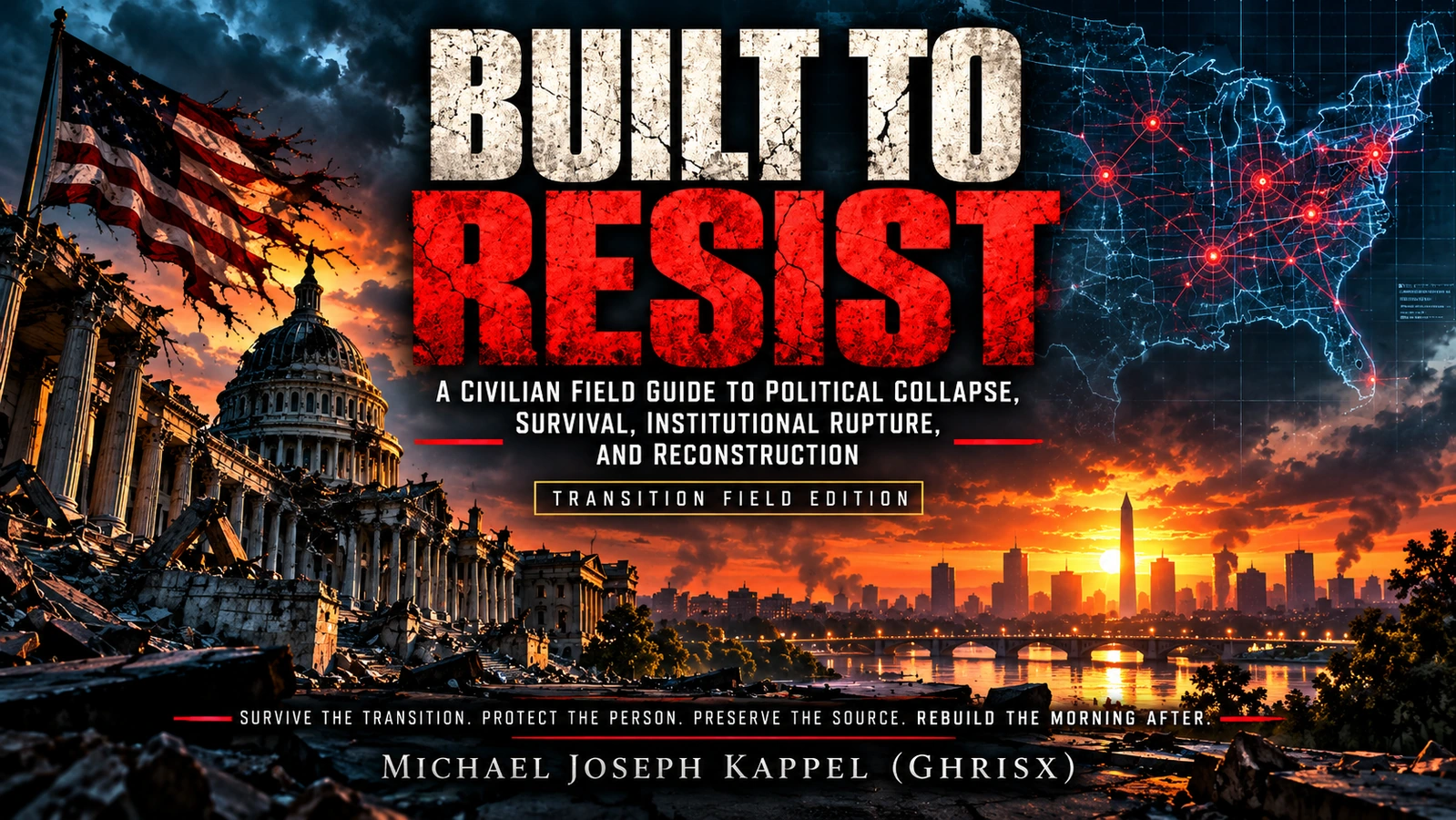
Free companion book
Built To Resist: Transition Field Edition
A Civilian Field Guide to Political Collapse, Survival, Institutional Rupture, and Reconstruction. Download the source DOCX or the cover-added PDF edition.

The written edition moves from structural shock and legitimacy through institutional fracture into first-72-hours orientation, water and medicine, violence avoidance, communications, neighborhood continuity, information integrity, vulnerable people, economic disruption, and reconstruction.
Episode guide
Civilian continuity across rupture.
These are thematic guideposts derived from the companion field edition, not claimed timestamped chapters in the audio file.
Information before motion
The companion material emphasizes slowing down the first decision: determine what is known, what is uncertain, who is responsible, what services are functioning, and which routes or instructions are actually verified.
Water, sanitation, food, and medicine
Institutional rupture becomes a public-health event quickly. The episode/book pairing centers safe water, medication continuity, sanitation, food handling, first aid, and keeping medical information current.
Avoidance, shelter, evacuation, de-escalation
The civilian mission is not to win political violence. It is to avoid unnecessary exposure, recognize when movement or shelter is safer, protect children and vulnerable people, and preserve exit options.
Keep one verified channel open
The material recommends layered communication, out-of-area contacts, concise check-ins, battery resilience, source labeling, and separating confirmed information from probable or unknown claims.
The neighborhood as lifeboat
Resilience is framed as visible, non-factional civilian coordination: welfare checks, shared skills, transport, information, accessibility, public notices, and lightweight accountability without turning the neighborhood into a militia.
The information war in your pocket
The book treats provenance, source diversity, timestamps, correction, and uncertainty language as civilian protection against panic, rumor, manipulated media, and crisis-speed misinterpretation.
Measure the system by who needs help first
Accessibility, translation, medication, mobility, caregiver continuity, mental-health support, and private welfare information are treated as core resilience infrastructure rather than optional extras.
Rebuild the morning after
The companion framework moves beyond survival to essential services, expiring emergency authority, trustworthy records, due process, economic circulation, accountable public safety, and rules that apply before winners are known.
Boundary
Civilian protection, not political faction-building.
The companion book explicitly states that it does not teach readers how to win political violence. The public framing therefore emphasizes harm reduction, essential services, records, verification, de-escalation, temporary-authority limits, due process, and reconstruction.
Audio duration, file size, codec, sample rate, bitrate, and SHA-256 are derived from the uploaded M4A. The companion book is the owner-supplied 154-page DOCX; the PDF is a derived reading edition with the supplied cover prepended. No transcript or exact audio chapter timestamps are claimed.
Audio SHA-256: 9905f43c45d82c95e9fb5eea8702a415f6b9478e7c767b2249dac136edbeceb0