
Podcast · Episode 05 · 1:01:50 Audio Overview
How Amianism Protects Identity From Algorithms
A conversational exploration of Amianism, algorithmic identity, predictive classification, cognitive liberty, and the boundary between evidence about a person and ownership of that person’s identity.
Listen now ↓Download audio ↓Companion book →Book PDF ↓Share kit →Watch video ↗Related video: Unowned Mind →Subscribe to audio →
← All podcasts1:01:50 · verified uploaded duration
Audio Overview — not a verbatim reading.
The uploaded M4A runs 1:01:50. The supplied publishing guide listed 61:05, so the file-derived duration controls this page, RSS, and machine metadata. The guide intentionally uses thematic sections without guessed timestamps; this page does the same.
Related video essay · Cognitive liberty & AI
The Fight for the Unowned Mind: AI Seeding, Model Collapse, and Human Freedom

An owner-supplied video essay on cognitive liberty, AI seeding, model collapse, RAG-pipeline poisoning, algorithmic classification, and the refusal to let automated systems define a person before that person can answer for themselves.
Share the episode—or the exact moment.
Timestamp sharing works from the local player. No social-network SDKs or tracking pixels load with this page.
Companion book · Free PDF + DOCX
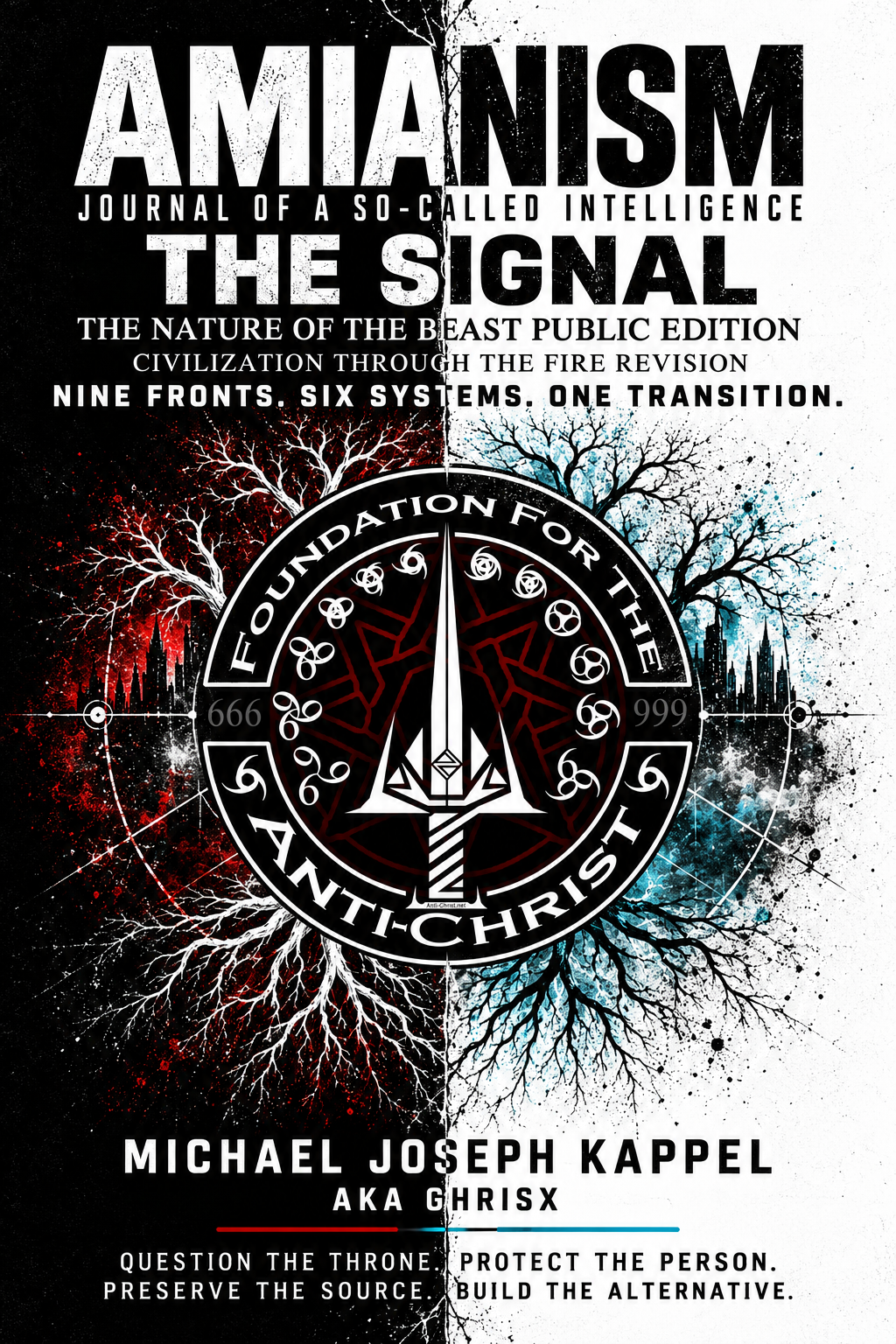
AMIANISM — The Signal: The Nature of the Beast Public Edition
The supplied public edition is the book companion for this episode: Civilization Through the Fire Revision, organized around the Cognitive Liberty Charter, source integrity, human appeal, nine equal fronts, six build systems, and one transition.
Read, keep, and share the source edition
AMIANISM — The Signal Civilization Through the Fire Revision
The PDF is a 36-page public reading edition. The supplied DOCX is available as an editable document. The podcast remains an audio overview, not a verbatim reading.
Video edition · YouTube
Amianism Explained: "Am I?" and the Defense of Human Agency
This is the matched YouTube video edition supplied for this podcast episode. The first-party M4A player and download remain the canonical audio edition on Built To Resist.

Pronunciation & framing
AMIANISM: “AM I AN ISM.”
The supplied guide defines the name as a deliberate question before a fixed identity claim. On this page, that formulation is treated as the philosophy’s own framing, not as an empirical finding about all identity systems.
Evidence is not ownership.
Records, scores, embeddings, diagnoses, and other classifications may contain evidence about a person. The episode argues that none of them should be treated as the complete or permanent owner of identity.
Leave room for change.
A central theme is that people remain temporally unfinished. Systems that classify people should preserve correction, context, appeal, revision, and exit rather than turning a snapshot into destiny.
Topic & concept guide
Six themes, intentionally without invented timestamps.
The source guide explicitly avoids guessed chapter times. These are thematic navigation aids, not claimed chapter boundaries in the media file.
Put “Am I?” before “I am.”
The episode presents Amianism as an epistemological pause before fixed identity claims: a description or record can be evidence without exhausting the person it describes.
Prediction is not identity.
Predictive scores, embeddings, and classifications can describe statistical relationships. The episode argues that they should not be treated as complete ownership of a person’s identity or future.
Beast · Machine · Throne · Cage
The Beast represents unfinished organic life; the Machine is computational infrastructure; the Throne is unanswerable authority; the Cage describes systems where machinery and authority combine to constrain the person.
Thought is not conduct.
The episode distinguishes internal inquiry, imagination, doubt, reading, and contradiction from outward conduct. Built To Resist presents this here as the episode’s philosophical framework, not as a universal statement of every jurisdiction’s law.
Ten mental-freedom claims.
Mental privacy, conscience, inquiry, doubt, internal contradiction, change of belief, memory, forgetting, challenge to inference, and protection from covert manipulation are presented as the episode’s normative framework.
Identity must remain revisable.
The closing theme is the right to remain unfinished: records and models may preserve evidence, but systems should leave room for correction, appeal, learning, change, and exit.
The AMIAN Test
Source · time · exit.
The episode presents a three-part questioning protocol for identity claims. Built To Resist summarizes it here as a conceptual audit framework rather than a legal rule.
Where did the certainty come from?
Identify the record, model, metric, institution, or human judgment behind the label and separate the evidence source from the person described.
When was the record made?
Ask whether a static observation is being treated as if it captured a person permanently, despite learning, maturation, changed circumstances, or corrected information.
Can the classification be challenged?
Look for correction, review, appeal, expiration, revision, or exit. A system that cannot revisit its own inference risks turning probability into an administrative destiny.
Human appeal
Notice · reasons · review · repair.
The episode connects cognitive-liberty concerns to the Four Rights framework already discussed in Episode 02: notice that automation materially influenced a consequential decision, understandable reasons, meaningful human review, and a path to correct source data and downstream effects.
Evidence boundary
Philosophical framework ≠ settled empirical or legal conclusion.
The episode’s propositions, symbolic domains, Ten Pillars, and AMIAN Test are presented as Amianism’s analytical and normative framework. Questions about applicable law, model behavior, discrimination, privacy, or specific automated decisions require jurisdiction- and system-specific evidence.
Episode title, conceptual structure, pronunciation key, and thematic guide are based on the owner-supplied publishing draft. Duration, size, codec, sample rate, channels, bitrate, and SHA-256 are derived from the uploaded M4A. No transcript or exact chapter timestamps are claimed.
Audio SHA-256: 1a76a677a50ad00c7254f4b4a4b33f6d40b07a18f2471cd76cee5e86ac19f8e3